3D Laser Scanning for Industrial Facilities
- Eduardo de Carvalho
- 5 days ago
- 3 min read

In industrial projects, accurate field information is essential. Existing plants often have undocumented modifications, outdated drawings, congested piping areas, equipment installed in tight spaces, and structural elements that must be considered before any new design, retrofit, or installation work begins.
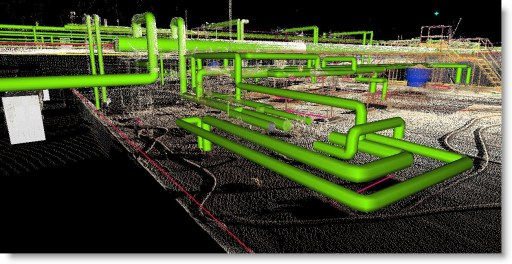
3D laser scanning provides a practical and reliable way to capture the real condition of an industrial facility. By scanning structures, piping systems, equipment, platforms, access areas, and plant layouts, it is possible to generate accurate point cloud data that supports engineering decisions and reduces the risk of field conflicts during fabrication and installation.

Understanding 3D Laser Scanning
3D laser scanning is a technology used to capture the physical conditions of an existing environment in digital form. The scanner measures millions of points in space and creates a point cloud, which represents the geometry of the scanned area.
For industrial facilities, this information can include piping routes, steel structures, tanks, vessels, equipment foundations, platforms, pipe racks, cable trays, access areas, and general plant layout conditions.
This data can then be used as a reference for engineering studies, as-built documentation, layout development, equipment installation planning, piping modifications, structural changes, and retrofit projects.

How the Process Works
The laser scanner is positioned at different locations inside the facility to capture the required areas. Each scan records the surrounding environment and generates a highly detailed set of 3D points.
After the field work, the scans are registered and processed using specialized software. The result is a consolidated point cloud that can be used for measurements, visual verification, coordination, and engineering design support.
Depending on the project requirements, the point cloud can also be used as a base for drawings, layouts, piping studies, equipment positioning, structural verification, and 3D modeling.

Benefits for Industrial Projects
Accurate As-Built Information
Many industrial plants have been modified over time, and the available drawings do not always reflect the actual field conditions. Laser scanning helps capture the real installation, reducing uncertainty during the design phase.
This is especially useful for:
Existing piping layouts
Steel structures and platforms
Equipment location and access areas
Pipe racks and supports
Tanks, vessels, and industrial equipment
Congested areas with limited space for new installations
Reduced Field Conflicts
One of the main advantages of laser scanning is the ability to identify potential interferences before fabrication or installation. By using point cloud data during the design process, engineers can verify available space, check routes, and reduce the risk of clashes between new and existing systems.
This can help avoid rework, installation delays, and unexpected field adjustments.
Better Planning for Retrofits and Expansions
Industrial retrofit projects require a clear understanding of the existing conditions. Laser scanning provides a reliable base for planning modifications, equipment replacements, new piping routes, structural reinforcements, platforms, and layout changes.
With accurate field data, project teams can make better decisions before work begins on site.
Support for Engineering Design
Point cloud data can be used as a technical reference for several engineering activities, including:
Piping routing studies
Equipment installation planning
Structural modifications
Platform and access design
Layout development
As-built drawings
Field verification
Construction and installation planning
By combining laser scanning with engineering expertise, the scanned data becomes more than a visual record. It becomes a practical tool for project development.
Improved Documentation
Laser scanning is also valuable for creating or updating as-built documentation. When existing drawings are incomplete, outdated, or unavailable, the point cloud can provide a reliable reference for developing updated layouts, drawings, and technical documentation.
This is especially important for facilities that need to plan future expansions, maintenance activities, or process modifications.
Applications in Industrial Facilities
3D laser scanning can be applied to a wide range of industrial environments, including manufacturing plants, food and beverage facilities, process plants, utilities areas, warehouses, mechanical rooms, pipe racks, platforms, and equipment areas.
Typical applications include:
Existing condition surveys
As-built documentation
Piping and equipment layout verification
Retrofit and expansion planning
Equipment replacement studies
Structural and platform modification support
Pipe routing and clash verification
Installation planning
A Practical Tool for Industrial Engineering
The value of 3D laser scanning is not only in capturing data, but in using that data correctly. For industrial projects, the point cloud must be interpreted with an engineering perspective, considering access, constructability, equipment clearances, maintenance space, piping routes, structural limitations, and installation requirements.
Nascar Engineering uses laser scanning as part of a practical engineering workflow to support accurate design, reliable documentation, and better project execution.
Conclusion
3D laser scanning is a powerful tool for industrial facilities where accurate field information is critical. By capturing existing structures, piping systems, equipment, and plant layouts, it provides a reliable basis for engineering design, as-built documentation, retrofit planning, and installation support.
For projects involving existing industrial installations, laser scanning helps reduce uncertainty, improve coordination, and support better technical decisions from the beginning of the project.

Comments